
ChemRegs Newsletter – October 2018
New ATP to CLP
The European Commission (EC) has published an amendment to Regulation (EC) No 1272/2008 on the classification, labelling and packaging of substances and mixtures, the CLP Regulation.
The CLP Regulation is the current system of classification and labelling for the supply and use of chemicals in the EU and implements the internationally agreed UN Globally Harmonized System of Classification and Labelling of Chemicals, known as the ‘GHS’. The UN GHS is updated, revised and improved every two years as needs arise and the current version is the 7th revision of the GHS (GHS Rev 7), published in 2017.
Table 3 of Annex VI of CLP contains the list of harmonised classification and labelling of hazardous substances. The table has been amended several times to reflect technical and scientific progress, by adding, deleting or modifying substances or their classification.
The use of the harmonised classification and labelling of a substance is mandatory in the EU. It has to be applied by all suppliers of the same substance, i.e. by manufacturers of substances, importers of substances or mixtures, producers or importers of explosive articles, downstream users including formulators (producing mixtures) and distributors.
The harmonised classification and labelling of hazardous substances is updated through an “Adaptation to Technical Progress (ATP)” adopted yearly by the European Commission, following the opinion of the Committee for Risk Assessment (RAC). Other changes to the legal text may also be implemented through an ATP e.g. to conform to the latest version of GHS.
The RAC examines the proposals for harmonised classification and labelling and gives an opinion on the proposed harmonised classification of substances as carcinogenic, mutagenic, toxic for reproduction or as a respiratory sensitiser, as well as other effects on a case-by-case basis.
The latest amendment to CLP is the 13th ATP (Commission Regulation [EU] No 2018/1480), which was published in the Official Journal of the European Union on 4 October 2018.
The 13th ATP amends the CLP by adding the RAC opinions on the harmonised classification of several substances to Table 3 of Annex VI and other minor amendments including retroactively applying the change of name of the Table in Annex VI from ‘Table 3.1’ to ‘Table 3’.
1 harmonised entry is deleted as it is no longer classified (EC 402-070-1), 18 entries are revised, and 16 new entries are added to the table.
Revised entries include sodium hypochlorite (CAS 7681-52-9, EC 231-668-3), which currently has a harmonised classification as Skin Corr. 1B, H314 and Aquatic Acute 1, H400 with a Specific Concentration Limit of EUH031: C ≥ 5 % . The revised harmonised classification is Skin Corr. 1B, H314; Eye Dam. 1, H318; Aquatic Acute 1, H400; Aquatic Chronic 1, H410; EUH031. The Specific Concentration Limit of EUH031: C ≥ 5 % remains the same, but M-Factors of M = 10 (acute) and M = 1 (chronic) are introduced.
Also revised is reaction mass of 5-chloro-2- methyl-2H-isothiazol-3-one and 2-methyl-2H-isothiazol-3- one (3:1) (CAS 55965-84-9). The acute toxicity for the dermal and inhalation routes is increased from category 3 to 2 and a new supplemental hazard EUH071 (“corrosive to the respiratory tract”) is added, based on the classification for acute inhalation toxicity and the corrosivity of the substance. The corrosive hazard has been lowered from Skin Corr. 1B to Skin Corr. 1C and although classification with skin corrosion means it is implicit that the substance will also cause serious damage to the eyes, the classification as Eye Dam. 1, H318 is added. As this is a potent skin sensitiser, the classification has changed from Skin Sens. 1 to Skin Sens. 1A. The environmental hazards remain the same but with added M-Factors of 100 for both acute and chronic hazards. The values for the Specific Concentration Limits are unchanged.
To give suppliers sufficient time to adapt the labelling and packaging of substances and mixtures to the new or revised classifications and to sell existing stocks, the new or updated harmonised classifications in the 13th ATP will apply from 1 May 2020. However, suppliers may choose to implement it before then.
It is advised that companies review their inventories of chemical substances and safety data sheets to ensure that the correct harmonised classifications are used.
Note – The 11th ATP to CLP was published in May 2018 (see our May Newsletter) and the 12th ATP is in the process of adoption and has yet to be published. This is because the time required for drafting, discussing and agreeing the ATPs means that they are not always published and adopted in numerical order. The 12th ATP will align CLP to the 6th and 7th revisions of GHS.
Other News
UN GHS Revision 8
The 8th revised edition of the UN Globally Harmonized System of Classification and Labelling of Chemicals (GHS Rev 8) is expected to be published in 2019.
Changes include:
Adoption of ISO standards.
Among the proposed changes is to update several ISO standards in Chapter 1.2 “Definitions and Abbreviations” and Chapter 2.2 “Flammable gases.”
Change of classification criteria for aerosols.
Aerosols will be classified in one of the three categories of this hazard class, depending on:
- their flammable properties;
- their heat of combustion; and
- if applicable, test results from the ignition distance test, the enclosed space ignition test and the aerosol foam flammability test, performed in accordance with sub-sections 31.4, 31.5 and 31.6 of the United Nations Recommendations on the Transport of Dangerous Goods, Manual of Tests and Criteria.
A new table, “Table 2.3.1: Criteria for aerosols” is added.
Minor changes regarding precautionary statements for skin irritation and serious eye damage.
A number of hazard classes provide sub-categories which can be adopted by competent authorities and by industry where the necessary data is available, e.g. “skin corrosion/irritation” categories, 1, 1A, 1B and 1C. However, the presentation of the precautionary statements in sections 2 and 3 of Annex 3 does not always reflect this accurately.
To enable appropriate allocation of precautionary statements for skin corrosion category 1 as well as for sub-categories 1A, 1B and 1C, the change is simply to replace the existing entry ‘1A, 1B, 1C’ in column 4 of Tables A3.2.2, A3.2.3, A3.2.4 and A3.2.5 with ‘1, 1A, 1B, 1C’.
To enable appropriate allocation of precautionary statements for serious eye damage/eye irritation as category 2 as well as for categories 2A and 2B, the change is simply to replace the existing entry ‘2A, 2B’ in column 4 of Tables A3.2.2 and A3.2.3, with ‘2/2A, 2B’ or with ‘2/2A’ as appropriate.
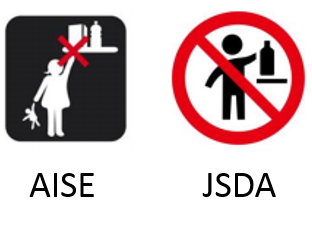
New precautionary pictograms for “keep out of reach of children”.
Most of the cases involving accidental child exposures to chemicals are associated with hazardous or potentially hazardous substances/mixtures not being properly stored out of children’s reach.
The use of simple and intuitive precautionary pictograms can be an effective means to convey essential safe use information on hazardous chemicals.
The following examples pictograms can convey the same message as the general Precautionary statement P102 (“keep out of reach of children”) and can be used to supplement this. One pictogram is a Safe Use Icon from the International Association for Soaps,Detergents and Maintenance Products (AISE) and the other was developed by the Japan Soap and Detergent Association (JSDA).
New labelling example for sets or kits.
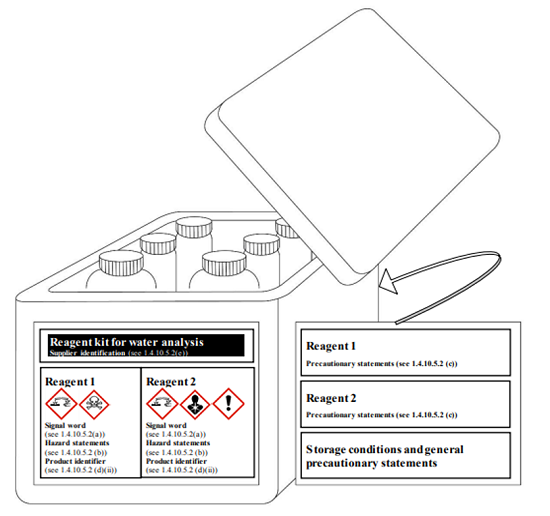
A new labelling example for sets or kits will be added.
A set or kit is a combination packaging intended for defined applications. Generally a set or kit contains two or more small removable inner containers. Each inner container contains different products which can be hazardous or not hazardous substances or mixtures.
The new example will illustrate ways to label sets or kits where the manufacturer/supplier or competent authority has determined there is insufficient space to place together on each inner container within the kit, the GHS pictogram(s), signal word and hazard statement(s). This may occur when, for example, the inner containers are small, or there are a large number of hazard statements assigned to the chemical, or the information needs to be presented in multiple languages, so all the information cannot be printed on the label in a size that is easily legible.
Two different scenarios where this may arise are illustrated, together with ways to provide the necessary GHS information. The full example can be seen here.
The UN GHS is not a legally binding document and countries adopting GHS use it as a building block approach and issue their own regulations or standards to implement these. In the EU the GHS is implemented by the CLP Regulation and the GHS will also be implemented by UK legislation in the event of a ‘No deal’ scenario following Brexit.
For more information on anything in this Newsletter, please contact us at info@chemregs.co.uk