

ChemRegs Newsletter – February 2022
Draft Amendments to ADR
At its 110th session, held in November 2021, the UNECE Working Party on the Transport of Dangerous Goods requested that a consolidated list be prepared of all the amendments to the Agreement concerning the International Carriage of Dangerous Goods by Road (ADR).
The amendments will be used for the next version of ADR (ADR 2023) that comes into force on 1 January 2023. This list will be submitted as an official proposal, in accordance with the procedure set out in article 14 of ADR, no later than 1 July 2022.
The requested consolidated list of amendments was published on 18 February (ECE/TRANS/WP.15/256) and contains all the amendments adopted by the Working Party at its 108th, 109th and 110th sessions (see ECE/TRANS/WP.15/251, annex I, ECE/TRANS/WP.15/253, annex I and ECE/TRANS/WP.15/255, annex II).
The draft amendment list has various additions and revisions to all chapters of ADR, including:
- Chapter 1.1 – a new section has been inserted, “1.1.4.7 Refillable pressure receptacles authorized by the United States of America Department of Transportation”. This has finally been added to ADR as a permanent solution after many years of discussion and a number of successive multilateral agreements. The reason for the requirement is that some products are only produced in the United States and there are specific logistics and technical issues that prevent the use of a RID/ADR approved pressure receptacle. The similar issue in the United States is that there are products requiring RID/ADR pressure receptacles that are filled into non-authorized DOT pressure receptacles for the United States of America.
- Chapter 1.2 – the title has been amended to read “DEFINITIONS, UNITS OF MEASUREMENT AND ABBREVIATIONS”. Various definitions have been revised, added or deleted; a new section has been inserted, “1.2.3 List of abbreviations”, which gives all the abbreviations, acronyms and abbreviated designations of regulatory texts that are used in ADR.
- Chapter 1.6 – this chapter concerns any transitional measures including dates by which certain provisions can still be used, e.g. 1.6.1.1 allows the use of the previous version of ADR for 6 months after the new version comes into force and so the specific dates are changed accordingly.
- Chapter 1.8 – sections 1.8.6 – 1.8.8 have been rewritten. These give the the administrative procedures and controls for tank inspection and approval and now adopt a harmonized approach applicable to all contracting parties.
- Chapter 3.2, Table A – various proper shipping names have been amended, including the deletion of UN 1169 “EXTRACTS, AROMATIC LIQUID” and the the revision of UN 1197 from “EXTRACTS, FLAVOURING, LIQUID” to “EXTRACTS, LIQUID, for flavour or aroma”. For radioactive material of UN Nos. 2908 to 2911, the entry for the tunnel restriction code is replaced by “(─)”. A new entry has been made to the list, UN 3550 “COBALT DIHYDROXIDE POWDER, containing not less than 10 % respirable particles.”
- Chapter 3.3 – various special provisions have been added, deleted and/or revised.
- Chapter 4.1 – various packing instructions have been revised.
- Chapters 4.2, 4.3, 4.4 and 4.7 – various editorial amendments have been made.
- Chapter 5.4 – A new section 5.4.1.1.3.2 has been added concerning special provisions for waste to allow for estimating the quantity. Other new sections include 5.4.1.1.22, 5.4.1.1.23 and 5.4.1.1.24, which cover “Special provisions for the carriage of substances carried in molten state” and “Special provisions for refillable pressure receptacles authorized by the United States of America Department of Transportation”.
- Chapter 6.2 (pressure receptacles and aerosols etc) contains quite a few amendments and updates to ISO standards.
- Chapter 6.8 (fixed tanks and tank containers etc) – a new sub-section 6.8.1.5 has been inserted, “6.8.1.5 Conformity assessment, type approval and inspections procedures” and other amendments to dates haven been made. Some TA, TC, TE and TT provisions have been revised.
- Chapter 6.9 – the current Chapter 6.9 “REQUIREMENTS FOR THE DESIGN, CONSTRUCTION, EQUIPMENT TYPE APPROVAL, TESTING AND MARKING OF FIBRE-REINFORCED PLASTICS (FRP) FIXED TANKS (TANK-VEHICLES) AND DEMOUNTABLE TANKS” becomes Chapter 6.13 and is also amended. A new Chapter 6.9 “REQUIREMENTS FOR THE DESIGN, CONSTRUCTION, INSPECTION AND TESTING OF PORTABLE TANKS WITH SHELLS MADE OF FIBRE-REINFORCED PLASTICS (FRP) MATERIALS” is inserted.
- Chapter 7.2 – the text in V6 is deleted and replaced by “(Deleted)”. New special provision “V15 IBCs shall be carried in closed vehicles or in closed containers” has been inserted.
- Chapter 7.5 – new text in 7.5.1.2 on cargo transport units and what needs to be checked to ensure it is structurally serviceable.
- Chapter 8.1 – section 8.1.2.1 has been amended to delete the requirement to provide the container/packing certificate with the transport document during the inland transport part of a container’s journey.
- Chapter 8.5 – special provision S1 (6) has been amended.
- Chapter 9.1 and 9.7 have been slghtly revised.
The full text of the list can be downloaded from here.
Other News
End of COVID restrictions
The UK government has now ended any remaining legal coronavirus restrictions in England, including removal of the requirement to self-isolate.
Please see GOV.UK guidance for further information.
There are different timescales for the removal of restrictions in Scotland and Wales.
Workplaces should continue to reduce the risk of COVID-19 transmission in line with any risk assessments. The following workplace controls still remain:
- adequate ventilation
- sufficient cleaning
- good hand hygiene
The HSE website has the latest information on continuing to reduce coronavirus transmission in workplaces. This includes advice from public health bodies and other government departments.
IATA FAQ on Dangerous Goods
The International Air Transport Association (IATA) has published a FAQ article to help industry get a better understanding of what they need to know about the transport of dangerous goods by air.
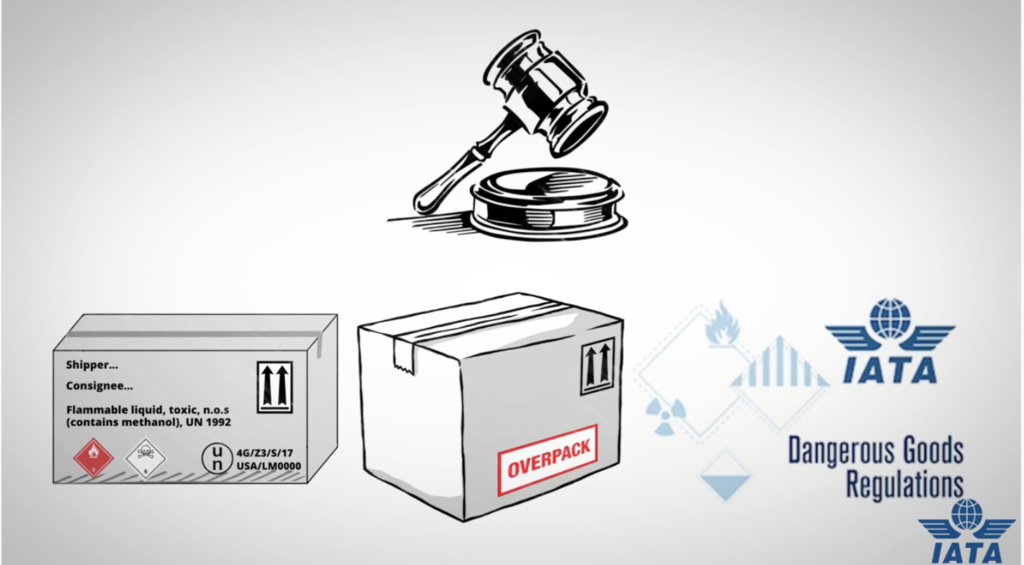
More than 1.25 million dangerous goods shipments are transported by air every year. With air cargo growth predicted to be 4.9% every year over the next 5 years, it follows that the number of dangerous goods shipments will rise significantly. Therefore, with so many dangerous goods being shipped by air, it is critical that safety regulations are followed precisely. IATA helps to identify the risks and works with ICAO (International Civil Aviation Organization) to amend the dangerous goods regulations that provide stakeholders with the most current guidelines on how to handle and ship dangerous goods safely.
The new IATA article is called “What You Need To Know About The Transport Of Dangerous Goods By Air”, and includes:
- What are dangerous goods
- What are examples of dangerous goods
- Why dangerous goods training is necessary
- What are IATA Dangerous Goods Regulations
- How often are the IATA Regulations updated
- What are the dangerous goods classes
- How are dangerous goods identified
- How are dangerous goods transported by air
- Who is involved in the transport of dangerous goods and what are their responsibilities
- Shipping & Handling
- Shippers and Operators responsibilities
- How to prepare dangerous goods for shipment by air
- How do I complete a dangerous goods declaration
- What to know about dangerous goods packaging
- How do you mark and label dangerous goods
The article can be found here.
For more information on anything in this Newsletter, please contact us at info@chemregs.co.uk