
ChemRegs Newsletter – July 2019
Transporting Dangerous Goods Safely and Load Security Enforcement Campaign Week (22 – 26 July 2019)
This month’s Newsletter is being issued today to give a heads up on the National Police Chiefs’ Council campaign to highlight the risks both to drivers and other road users if dangerous goods aren’t transported properly.
The police, working with the Driver & Vehicle Standards Agency (DVSA), will this week be carrying out proactive enforcement to identify unsafe vehicles and take appropriate action to keep the roads safe.
One of the recurring issues for the enforcement authorities is Load Securing.
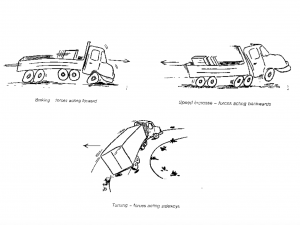
At its most basic level, load securing is about stopping the dangerous goods moving inside the vehicle when the vehicle is accelerating, braking or going around bends.
The image below is a classic example of unsecured dangerous goods.
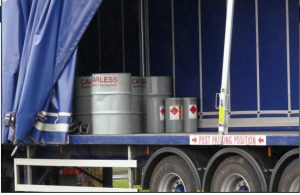
If the driver performs an emergency stop, the drums of dangerous goods will either move forward and hit the bulkhead and split, thus losing the contents, or they will come out of the side curtains and injure people, cause damage, and if split, cause a pollution incident which is very expensive to remedy. Unstable loads can also fall out of or off the vehicle when it arrives for unloading.
It’s very important that dangerous goods are loaded and secured to stop them moving around inside the vehicle. It is easy to do and can save huge sums of money but more importantly, save injuries and lives.
Therefore, if you are responsible for consigning, loading/unloading or transporting dangerous goods, it might be worthwhile to pass the link below to those involved.
https://content.govdelivery.com/accounts/UKHSE/bulletins/252526a
While drivers are responsible for the safety of their vehicle on the road, consignors and vehicle operators are also responsible for ensuring that the load a vehicle carries is safe and secure from the point of loading right through to unloading.
See also the link to the latest DVSA load securing guidelines https://www.gov.uk/government/publications/load-securing-vehicle-operator-guidance/load-securing-vehicle-operator-guidance
There is also the IMO/ILO/UNECE Code of Practice for Packing of Cargo Transport Units (CTU Code). The CTU Code, a joint publication of the International Maritime Organization (IMO), the International Labour Organization (ILO) and the United Nations Economic Commission for Europe (UNECE), is a non-mandatory global code of practice for the handling and packing of shipping containers for transportation by sea and land.
It is available for download from https://www.unece.org/fileadmin/DAM/trans/doc/2014/wp24/CTU_Code_January_2014.pdf
Other News
ECHA’s chemicals database updated
ECHA has introduced several new features and improvements in their chemicals database. These include new information in substance Infocards, quick links to deeper datasets for each substance and more visibility on nanomaterials.
The properties of concern section in the Infocards has been extended and the search possibilities for substances based on these properties has been likewise extended.
The current regulations and regulatory activities section has been restructured and the different regulatory lists are now laid out by legislation in expandable blocks, with explanations why the substances are on key lists.
The other identifiers section has also been improved and restructured to include all public identifiers, including translated names and where available allowing to search them in different EU languages.
To help with all of these improvements and new features, the Infocard integrated help system has been updated with extensive explanations and links to more information.
There are also new quick links to key datasets for each substance, giving users a faster way to browse through more data-rich datasets, such as the Brief Profiles, REACH registered substance factsheets, the Classification and Labelling (C&L) Inventory, biocides data and the public activities coordination tool (PACT).
The advanced search has also been extended and restructured, allowing new search possibilities. For instance, the advanced classification and labelling search now also covers Seveso Directive data.
The Infocards now have a new nanomaterial form section, which shows whether the substance is placed on the EEA market in nanoform and provides links to the EU Observatory for Nanomaterials (EUON). Through the EUON’s search for nanomaterials, information on over 300 nanomaterials on the EU market can be found and linked to hazard data. The search uses data from REACH registrations, the cosmetic ingredients notification portal as well as the French and Belgian national inventories.
Finally, disseminated REACH registration data will now start to be automatically linked to the OECD’s eChemPortal.
GHS Revision 8 (2019)
The Globally Harmonized System of Classification and Labelling of Chemicals 8th Edition has now been published in hard copy.
The eighth revised edition of the GHS contains various new or revised provisions including, inter alia:
- new classification criteria, hazard communication elements, decision logics and guidance for chemicals under pressure;
- new provisions for the use of in vitro/ex vivo data and non-test methods to assess skin corrosion and skin irritation;
- miscellaneous amendments to clarify the classification criteria for Specific Target Organ Toxicity;
- revised and further rationalized precautionary statements and an editorial revision of Sections 2 and 3 of Annex 3;
- new examples of precautionary pictograms to convey the precautionary statement “Keep out reach of children”;
- a new example in Annex 7 addressing labelling of sets or kits;
- guidance on the identification of dust explosion hazards and the need for risk assessment, prevention, mitigation, and hazard communication.
The electronic (pdf) version is not yet available.
For more information on anything in this Newsletter, please contact us at info@chemregs.co.uk