
ChemRegs Newsletter – March 2018
Coming to a hazardous label near you…….Unique Formula Identifier

A new element will be appearing on CLP labels from 2020.
The unique formula identifier, or UFI for short, is a 16-character code that will be required on the label of all products that contain a hazardous mixture in the EU.
The UFI will be a unique number assigned by companies to their products, to be used by the poison centre of the country that the product is marketed in. It will be a major addition to the label of products that currently fall within the scope of the CLP Regulation and are classified for health and physical hazards.
It is required under Article 45 and the new Annex VIII of the CLP Regulation, whereby companies placing certain hazardous mixtures on the market have to provide information to national appointed bodies. The national appointed body or bodies may be a Member State Competent Authority on CLP (MSCA), a poison centre, a National Health Authority or another body appointed by the MSCA. In those cases where the appointed body is not the poison centre, the national appointed body or bodies make the submitted information available to the poison centres. A list of national appointed bodies is available at the ECHA Poison Centre website: https://poisoncentres.echa.europa.eu/
The appointed bodies must ensure that the information received is kept confidential and is only used for the purposes of emergency health response.
Companies placing hazardous mixtures on the market will have to submit specific product information, including the UFI, to the appointed body. In particular, the safety data sheet (SDS) for the mixture will represent one of the main sources of information for a company that is preparing a submission to a poison centre. The submitted information has to be consistent with the SDS and the SDS itself may need to be part of the submission to the appointed body.
This specific product information includes, inter alia:
- The composition of the mixture (i.e all the ingredients, both hazardous and non-hazardous);
- The trade name of the mixture;
- The colour and appearance;
- The pH, where applicable
- The type(s) and size(s) of the packaging;
- Use (consumer, professional, industrial, or a combination of any of the three);
- The product category;
- Toxicological information.
This information is quite straightforward, but the last two bullet points need a little more explanation.
A hazardous mixture must be assigned a single ‘product category’ by the company to describe its intended use. The European product categorisation system (EuPCS) may also be used by EU appointed bodies or poison centres to help with reporting and monitoring of poisoning incidents.
Examples of intended uses include use as an adhesive, as a decorative paint, or as a dishwashing detergent.
If mixtures have dual or multiple uses, then only the main intended use is selected. For example, cleaning products containing a disinfectant are considered to be a biocidal product.
The EuPCS only covers those categories for mixtures that are within the scope of Article 45 of CLP – namely, mixtures classified as hazardous based on their health effects (skin corrosion, serious eye damage etc) or physical properties (flammability etc). Environmental hazards and other product categories, including ‘Cosmetics, food and tobacco products’, ‘Medicinal products and medical devices’ and ‘Drugs of abuse’, are out of scope and not included.
However, mixtures which are not subject to submission obligation may still do so on a voluntary basis. In fact, although it is not mandatory, submission of relevant information about mixtures not classified on the basis of their health or physical effects is encouraged, to help the poison centres activities.
The toxicological information element is essentially Section 11 of the SDS, which gives information on any health effects. In Section 11 of the SDS there may be a plethora of toxicological information, but quite often there is information on the ‘median level dose’ for acute toxicity. This is usually expressed as LD50 or Lethal Dose 50.
What is LD50?
Hazardous substances have a wide range of pathways to damage our health, for example one substance may damage the liver whilst another substance would be toxic to the kidneys. Since different chemicals cause different toxic effects, comparing the toxicity of one with the other is difficult and subject to individual interpretation.
We could say that liver damage is observed when 10 grams of substance A is ingested, and kidney damage is observed when 5 grams of chemical B is ingested.
However, this information does not tell us if substance A or B is more toxic because we do not know which damage is fatal or harmful.
Therefore, to compare the toxicity or potency of different substances, we must have a metric that measures the same effect. One way was to carry out lethality testing (the LD50 tests) by measuring how much of a chemical is required to cause death.
LD50 is the term used to describe the minimum dose of a specific substance that will kill half of a sample of organisms exposed i.e 50%. Tests are usually conducted on rats and mice, using oral and dermal routes of exposure. Tests using inhalation exposure use the term LC50, which is similar to LD50 but is the lethal concentration of the chemical in the air that will kill 50% of the test animals with a single exposure.
The lower the value of the LD50, the more toxic the drug. For example, an LD50 value of 5 milligrams would be considered far more dangerous than an LD50 value of 500 milligrams.
Once the LD50 is known, it can then be applied to humans using extrapolation tables.
The vast majority of LD50 and LC50 tests are historical, and the use of animals for testing is being phased out with the introduction of non-animal tests. In fact, several countries have banned the use of animal testing outright. The results of historical lethality tests have been recorded so they do not need to be repeated.
The UFI aims to establish a unique link between the product and its toxicological effects.
Hopefully, this simple scenario will explain how the UFI is used in practice. A doctor is treating a casualty who has swallowed a household-cleaning product. The ambulance crew, fortunately, has brought the container with them. The doctor contacts the poison centre and gives the UFI number that is on the label of the container. The poison centre immediately retrieves the toxicological information and relates it to the doctor. Appropriate medical decisions can now be made with this empirical information.
There were about 600 000 calls to poison centers in the EU last year and roughly half of the cases related to accidental exposures involving children.
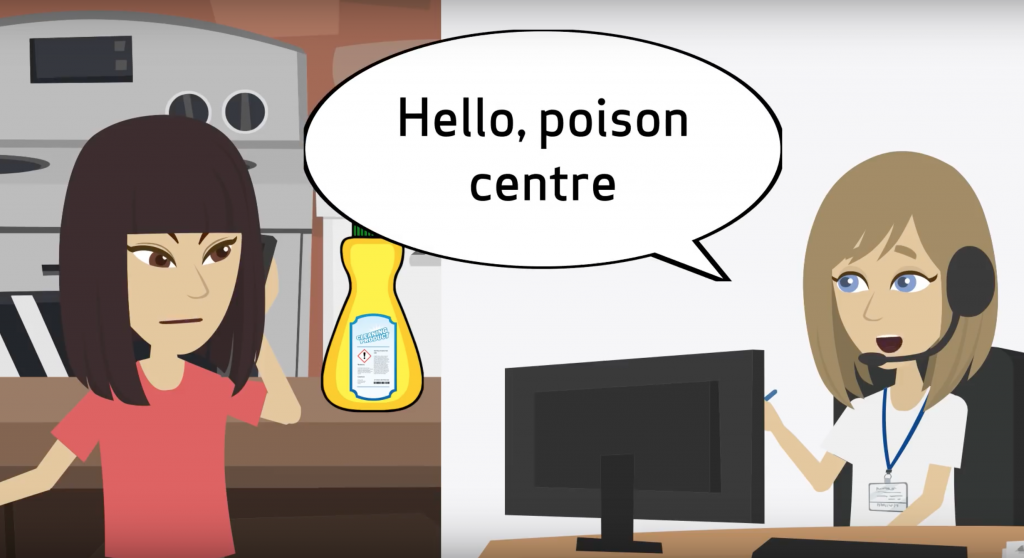
(image from ECHA video)
If your product falls within the CLP Regulation, then it will probably need a UFI and the information given to the poison centres from 1 January 2020. The timeline for implementation is as follows:
- Consumer uses: from 1 January 2020
- Professional uses: from 1 January 2021
- Industrial uses: from 1 January 2024
The UFI must go on the CLP label with the pictograms and hazard statements.
The number is unique to the hazardous product, therefore even if a company does not make or import a hazardous mixture and only re-packages or re-labels it, they may need to create their own UFI for the product. A software application (the UFI generator) has been developed to allow industry to generate UFIs. ECHA provides the tool and the user manual free of charge and both are available on the ECHA Poison Centres website at:
https://poisoncentres.echa.europa.eu/
To create a UFI for a mixture, ECHA is recommending to use a company’s VAT number (or other ‘company key’) and a mixture-specific formulation number. Entering these two numbers into ECHA’s UFI Generator online tool will produce the UFI code. The VAT number is a key element to ensure that the UFI is unique so that no overlap occurs between UFIs generated by different companies. However, for companies not having a VAT number, an alternative method for generating a UFI exists.
ECHA has produced a briefing note called “The UFI and what it means for your product labels” as well as draft guidance on what information poison centers’ require from 1st January 2020. Both are available on the ECHA Poison Centres website.
It will become more important to have an up to date REACH compliant safety data sheet for hazardous mixtures, as SDSs represent one of the main sources of information for a company that is preparing a submission to a poison centre.
Other News
EU-OSHA 2018-2019 Campaign
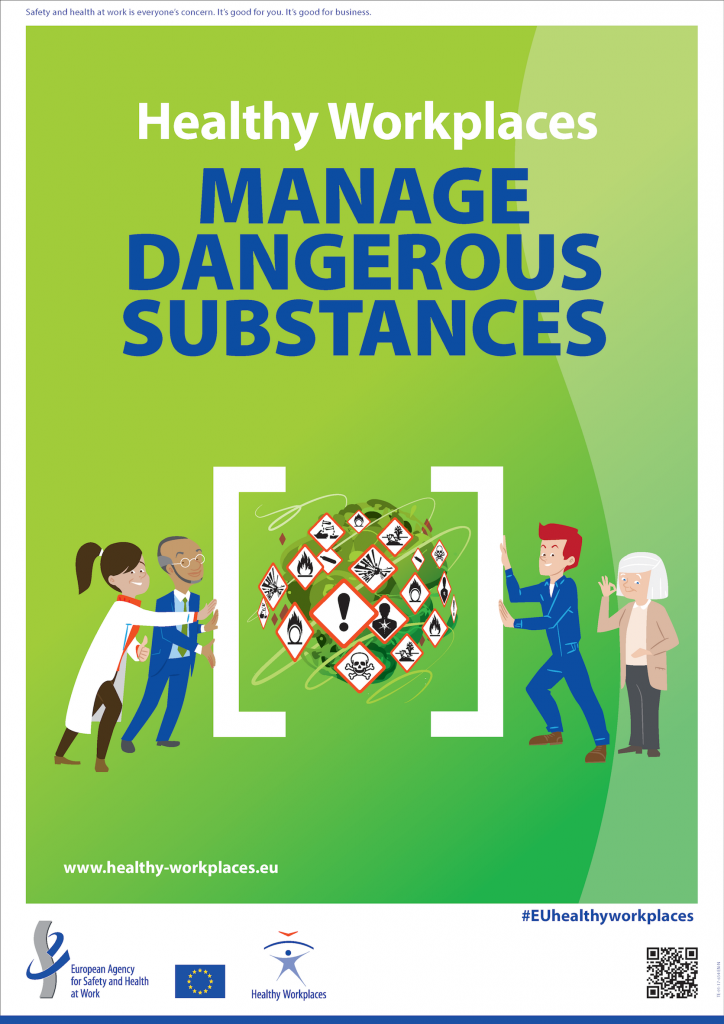
The European Agency for Safety and Health at Work (EU-OSHA) have announced their new 2018-19 Campaign — ‘Healthy Workplaces Manage Dangerous Substances’. The new campaign is being launched on 24 April 2018 and aims to raise awareness of the risks posed by dangerous substances in the workplace and to promote a culture of risk prevention.
The campaign objectives are:
- To raise awareness of the importance of preventing risks from dangerous substances, helping to dispel common misunderstandings
- To promote risk assessment by providing information on practical tools and creating opportunities to share good practices, focusing specifically on:
- eliminating or substituting dangerous substances in the workplace
- the hierarchy of prevention measures (i.e. following the hierarchy outlined in legislation so that the most effective type of measure is always selected).
- To heighten awareness of risks linked to exposures to carcinogens at work by supporting the exchange of good practices; EU-OSHA is a signatory to the covenant committing to the EU Carcinogens Roadmap.
- To target groups of workers with specific needs and higher levels of risks by providing tailored information as well as examples of good practices. The risks might be higher because these workers are inexperienced, uninformed or physically more vulnerable, or because they frequently change jobs, or work in sectors where awareness of the issue is low, or because of a higher or different physiological sensitivity (e.g. in young apprentices, or differences between men and women).
- To increase knowledge of the legislative framework that is already in place to protect workers, as well as highlighting policy developments.
There is a selection of resources on the dedicated campaign website at www.healthy-workplaces.eu , including:
- a comprehensive campaign guide ;
- series of info sheets on priority topics;
- a practical e-tool offering guidance on managing dangerous substances at work;
- a database containing case studies, tools and other good practice materials;
- presentations, posters, leaflet and infographics that can be used to promote the campaign;
- the campaign toolkit to support you in your campaign activities;
- database of audio-visual material for awareness-raising and animated videos featuring Napo;
- helpful links.
For more information on anything in this Newsletter, please contact us at info@chemregs.co.uk