

ChemRegs Newsletter – November 2025
EU CLP Revision Delayed
The EU has delayed the implementation of key parts of the new revised EU Classification, Labelling and Packaging (CLP) Regulation (Regulation (EU) 2024/2865) to 1 January 2028. This has no effect on the GB CLP Regulation, which has not been revised since 2021 and is currently undergoing a consultation process on potential reforms (see our June Newsletter)
This delay (a move known as a ‘Stop-the-clock’ mechanism) gives companies, especially Small and Medium-sized Enterprises (SMEs), more time to adapt to the new rules and aims to simplify the overall compliance timeline. The original deadlines in mid-2026 and early 2027 were considered burdensome and calls were made by industry for a postponement. It also amends the timelines for relabelling and mandatory formatting requirements, and rules on advertising, distance sales and fuel pump labelling.
This change is part of the broader Omnibus VI package, which aims to simplify EU chemical legislation and reduce compliance costs while maintaining high protection levels. In addition to the EU CLP Regulation, the Omnibus VI package also proposes amendments to the EU Cosmetics Regulation, introducing clarifications and streamlining compliance procedures.
The Council of the European Union formally approved the delay on 18 November 2025, following the European Parliament’s vote on 23 October 2025.
HSE Accident and Near-miss Tool
HSE and their publishing partner TSO (The Stationary Office) have launched a new Accident and Near-miss Tool.
The Accident and Near-miss Tool is designed to help organisations streamline incident reporting and aid compliance with the Reporting of Injuries, Diseases and Dangerous Occurrences Regulations (RIDDOR).
The tool automates the collection of accident and near-miss records, allowing teams to filter by location, type or theme. This enables the user to understand how risks occur and take informed preventive measures.
The tool guides duty holders through HSE’s step-by-step investigation framework (HSG245), providing advice on investigating incidents and preventing recurrence. This supports accurate reporting, consistent investigation and effective incident management.
Background – The Safety Pyramid
The Safety Pyramid (or Heinrich’s Triangle) is a widely used framework in health and safety management. It shows the relationship between near misses, minor injuries/accidents, and serious incidents (including major injuries or fatalities).
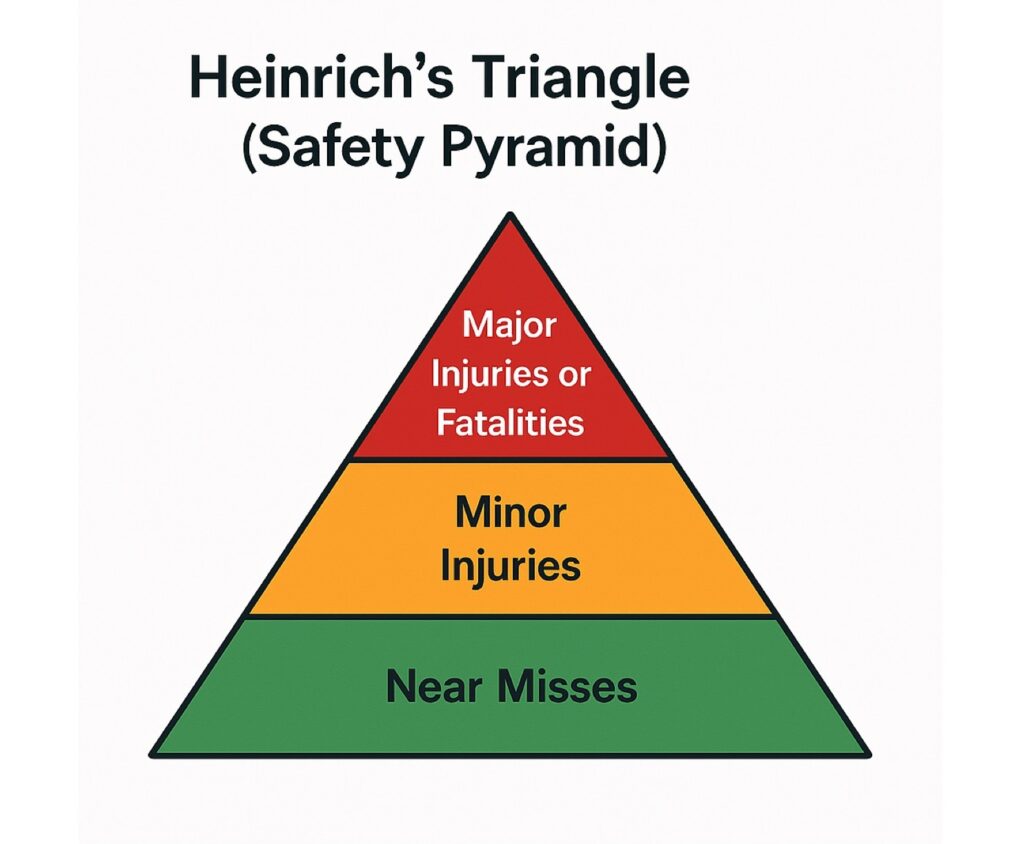
For every serious incident e.g. major injury or fatality, there are many more minor accidents/injuries and even more near misses – highlighting the importance of addressing smaller events to prevent major ones.
Dangerous occurrences
By law, certain workplace injuries, near misses and work-related diseases must be reported to HSE under RIDDOR.
Accidents
If your organisation has more than 10 employees, you must keep a physical or digital accident book under social security law. Keeping records helps identify accident patterns, manage risk and support insurance claims.
Near misses
Near misses are incidents that were narrowly avoided. They are valuable indicators of weaknesses in processes, safeguards or culture. Capturing and analysing every near miss, incident and accident helps identify and address potential risks. Reviewing the underlying causes of near misses helps to reduce risk, improve safety and saves time and money.
How to get the Accident and Near-miss Tool
The Tool works on any device via an online browser and the cost for a licence is £99.00 + VAT per year, per user account. The licences run for 12 months from the date access is granted.
Each user account provides administrative access to view, manage and analyse records. Workers can submit unlimited accident and near-miss reports, regardless of how many user accounts an organisation holds.
User accounts are intended for individuals responsible for:
• completing and submitting RIDDOR reports
• investigating incidents and reviewing findings
• overseeing compliance and ensuring accurate reporting
If an organisation has several people in these roles, they will need multiple user accounts.
The Tool has a simple setup with step-by-step guidance and users can configure the system by site, department, activity or function.
It will automatically flag potential RIDDOR-reportable incidents and sends instant alerts to designated contacts. All submissions are securely stored in a searchable central database.
An explainer video is also available on Youtube.
To order or for more information from the HSE:
Demo: online booking
Email: hseorders@tso.co.uk
HSE Phone: +44 (0)1603 972959
GB BPR Article 95 Changes
Regulations have been laid in the UK Parliament to change the data protection end date in Article 95(5) of the GB Biocidal Products Regulation (GB BPR) to 31 December 2030.
The Biocidal Products (Data Protection Periods) (Amendment) 2025 were laid in Parliament on 25 November 2025.
These Regulations will come into force on 30 December 2025, subject to successful completion of Parliamentary processes.
The purpose of these Regulations is to change the date that regulatory data protection ends for active substances in the GB Review Programme, as set out in Article 95(5) of GB BPR. The data protection period has been increased by 5 years, from 31 December 2025 to 31 December 2030.
Therefore, data submitted for the first time in support of an active substance in the GB Review Programme is protected until either:
• 10 years from the first day of the month following the date of approval or inclusion onto the GB Simplified Active Substance List, or
• 31 December 2030
The Regulations also make minor technical changes to ensure Article 95(5) works as intended and updates the references in Article 95(5) and Article 95(3) to assimilated Regulation (EU) No 1062/2014 (which sets out the systematic work programme for evaluating existing active substances in biocidal products).
For more information on anything in this Newsletter, please contact us at info@chemregs.co.uk