

ChemRegs Newsletter – May 2024
ADR 2025
UN ECE has published the consolidated lists of draft amendments to ADR by the Working Party on the Transport of Dangerous Goods. These amendments are expected to take effect on 1 January 2025, subject to adoption by the ADR Contracting Parties for inclusion in ADR 2025.
The files include three separate papers: ECE/TRANS/WP.15/265 – the draft amendments that were presented to the April session of WP15 (see also our March 2024 Newsletter); ECE/TRANS/WP.15/265/Corr.1 – a list of corrections to those draft amendments; and ECE/TRANS/WP.15/265/Add.1 – further draft amendments that were adopted at the April 2024 meeting.
A new paragraph has been added to the list of exemptions in Chapter 1.1.3 to cover the carriage of waste dangerous goods by private individuals:
“1.1.3.1 Rename current sub-paragraph (a) as sub-paragraph (a) (i).
After sub-paragraph (a) (i), add the following new sub-paragraph (ii):
“(ii) The carriage of dangerous goods by private individuals in the limits defined in paragraph (a) (i) intended initially for their personal or domestic use or for their leisure or sporting activities and which are carried as waste, including the cases when these dangerous goods are no longer packaged in the original package for retail sale, provided that measures have been taken to prevent any leakage under normal conditions of carriage;”.”
There are various new definitions in Chapter 1.2 and include new definitions for “Recycled plastics material” and “Degree of filling”.
New transitional measures have been added in Chapter 1.6. including measures for tank containers, fixed tanks (tank-vehicles) and demountable tanks constructed before 1 July 2025 in accordance with the requirements in force up to 31 December 2024, but which however do not conform to the requirements of ADR applicable from 1 January 2025, may continue to be used.
Chapter 2 has various changes including that sub-section 2.2.9.1.7 in Class 9 is now divided into two detailed sub-sections – 2.2.9.1.7.1 covering lithium batteries and 2.2.9.1.7.2 covering sodium ion batteries. This is followed by further changes to cover the transport of sodium ion batteries in the rest of the ADR.
Chapter 3 has many changes to DG List entries and to special provisions. New entries include:
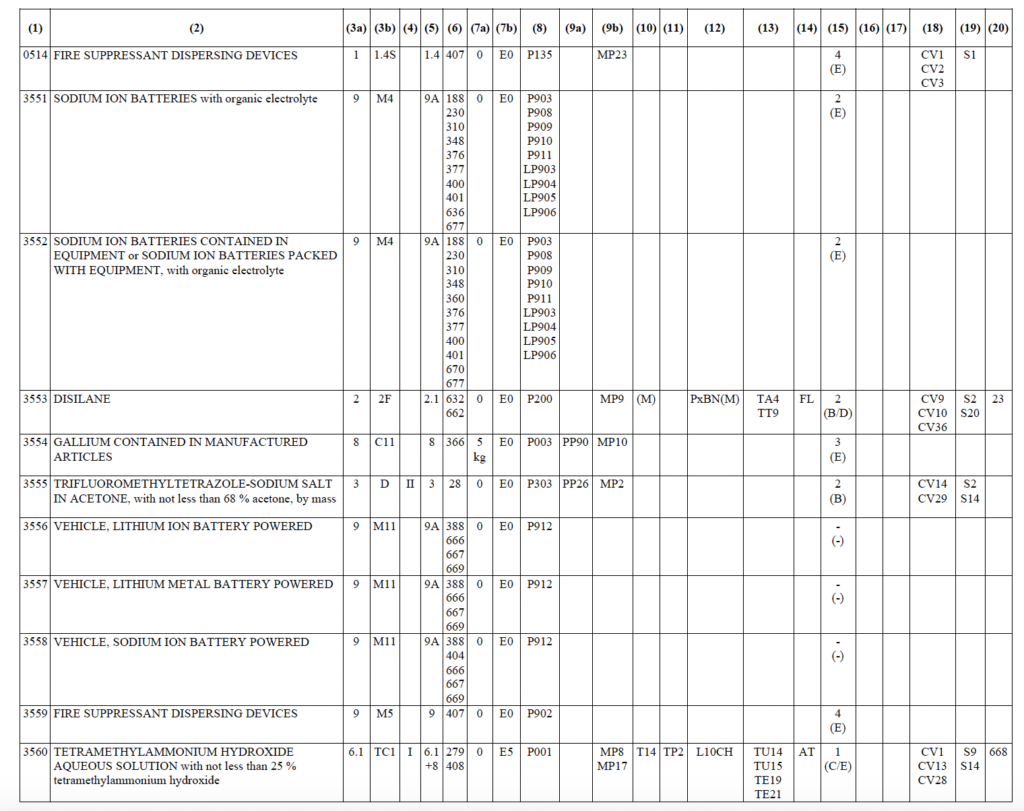
SP188, formerly just for lithium batteries, now includes sodium ion batteries, as do various other special provisions. A new special provision, SP 678, has been added for waste consisting of objects and materials contaminated with free asbestos (UN Nos. 2212 and 2590).
A new sub-section 4.1.1.5.3, has been added to Chapter 4.1 General provisions for the packing of dangerous goods in packagings, including IBCs and large packagings. This allows the carriage of waste, under certain conditions, to be transported in inner packaging of different sizes and shapes packed into one outer packaging. The inner packaging may contain liquids or solids. The waste contained in the one outer packaging will be assigned to the most appropriate entry but more than one entry may be used, if needed. By derogation from 5.1.4, the only marking and labelling on the outer packaging corresponds to the entry or entries assigned to the outer packaging.
This of course means an adaption in the corresponding shipping document is necessary – see new sub-section 5.4.1.1.3.3 “Special provisions for the carriage of waste in inner packagings packed together in an outer packaging.
For carriage in accordance with 4.1.1.5.3, a statement shall be included in the transport document, as follows “Carriage in accordance with 4.1.1.5.3”. The additional statement prescribed in 5.4.1.1.3.2 is not necessary. For example: “UN 1993 WASTE FLAMMABLE LIQUID, N.O.S., 3, III, (E); CARRIAGE IN ACCORDANCE WITH 4.1.1.5.3”.
Information in the transport document in accordance with 5.4.1.1, shall be based on the entry or entries assigned to the outer packaging in accordance with 4.1.1.5.3 (d). The technical name, as prescribed in chapter 3.3, special provision 274, need not be added.”
As per usual, P200 on the packing of gases contains various amendments and the following packing instructions have also been amended: P003, P006, P203, P206, P301, P404, P405, P410, P501, P505, P520, P600, P601, P602, P603, P620, P650, P800, P803, P804, P901, P902, P903, P904, P905, P908, P909, P910, P911, R001, IBC02, IBC03, IBC05, IBC06, IBC07, IBC08, IBC100, IBC520, LP03, LP03, LP902, LP903, LP904, LP905, LP906. New packing instructions have been added P303 (applies to UN 3555) and P912 (applies to UN Nos. 3556, 3557 and 3558).
There are a number of changes in Chapter 5 for lithium and sodium batteries. The lithium ion mark becomes lithium battery or sodium ion battery mark.
Other amendments are made to Chapters 6-9, but are too detailed to be covered in this article.
It must be emphasised that these all of the proposed changes and that they still need to be formally agreed before they are fully adopted into ADR 2025.
USA Hazard Communication Standard (HCS) 2024
The US Occupational Safety and Health Administration (OSHA) has finalised changes to its Hazard Communication Standard (HCS), making this the first significant update to the HCS in more than ten years.
OSHA’s HCS final rule was published May 20, 2024, in the Federal Register. This OSHA 2024 update amends the HCS to conform to the United Nations’ Globally Harmonized System of Classification and Labelling of Chemicals (GHS). Focused primarily on GHS Revision 7, it addresses issues that arose during the implementation of the 2012 HCS update when OSHA updated the standard to align with the third revision of the GHS.
The revised HCS 2024 aligns more closely with US. trading partners, including Canada, Australia, New Zealand, and Europe. The decision to align with Canada has been a priority as it helps facilitate cooperation between the two countries, eases compliance for employers who participate in both markets, and strengthens worker protections by providing harmonized hazard communication standards across trade borders.
The effective date for the revised Hazard Communication Standard is July 19, 2024. Substance labels and safety data sheets must be updated to the new standard by January 19, 2026. Mixture labels and SDS must be updated to the new standard by July 19, 2027.
A Side-by-Side Comparison of HCS 2012 to HCS 2024 can be seen here: https://www.osha.gov/sites/default/files/HCS_side-by-side.pdf
IATA Addendum
An addendum has been issued for the IATA Dangerous Goods Regulations 65th Edition (English) and was posted on 30 April 2024. It mainly concerns new or amended State Variations (Section 2.8.2), new or amended Operator Variations (Sections 2.8.3 and 2.8.4), and revised contact details in Appendix D.1.
The addendum can be downloaded from here: https://www.iata.org/contentassets/90f8038b0eea42069554b2f4530f49ea/dgr_65_addendum_en.pdf
For more information on anything in this Newsletter, please contact us at info@chemregs.co.uk