

ChemRegs Newsletter – May 2023
New hazard classes in EU CLP
New hazard classes for substances and mixtures entered into force on 20 April 2023 in the EU.
The European Commission has published a Delegated Regulation amending the EU CLP Regulation, which sets out new hazard classes and criteria for the classification, labelling and packaging of substances and mixtures.
It applies to all chemical substances and mixtures placed on the EU market under REACH. It also applies to active substances in biocidal products and plant protection products, which are normally prioritised for harmonised classification in the EU.
This EU legislation is binding to manufacturers, importers, downstream users and distributors placing substances on the European Union market. Member States must also refer to the new hazard classes and criteria when making proposals for harmonised classification and labelling.
The new hazard classes are:
- ED HH in Category 1 and Category 2 (Endocrine disruption for human health)
- ED ENV in Category 1 and Category 2 (Endocrine disruption for the environment)
- PBT (persistent, bioaccumulative, toxic), vPvB (very persistent, very bioaccumulative)
- PMT (persistent, mobile, toxic), vPvM (very persistent, very mobile)
The new hazard classes also have new EU hazard statements:
| Hazard class and category code | Hazard statement code | Hazard statement |
| ED HH 1 | EUH380 | May cause endocrine disruption in humans |
| ED HH 2 | EUH381 | Suspected of causing endocrine disruption in humans |
| ED ENV 1 | EUH430 | May cause endocrine disruption in the environment |
| ED ENV 2 | EUH431 | Suspected of causing endocrine disruption in the environment |
| PBT | EUH440 | Accumulates in the environment and living organisms including in humans |
| vPvB | EUH441 | Strongly accumulates in the environment and living organisms including in humans |
| PMT | EUH450 | Can cause long-lasting and diffuse contamination of water resources |
| vPvM | EUH451 | Can cause very long-lasting and diffuse contamination of water resources |
Application dates
The new rules came into force as of 20 April 2023. EU Member States can now make proposals for harmonised classification and labelling (CLH) with the new hazard classes and manufacturers, importers, downstream users and distributors can self-classify their substances and mixtures accordingly.
There are transitional periods from the entry into force of the Delegated Regulation, during which manufacturers, importers, downstream users and distributors are not yet required to classify their substances or mixtures according to the new hazard classes. During these periods, the new hazard classes can be applied on a voluntary basis.
At the end of the transitional periods, all manufacturers, importers, downstream users and distributors in the EU must apply the new hazard classes.
For new substances on the EU market, companies need to comply with the new rules from 1 May 2025, whereas substances that have already been on the EU market, companies have until 1 November 2026 to comply.
Separate transition times apply for mixtures. New hazard classes apply from 1 May 2026 to new mixtures, whereas companies have until 1 May 2028 to update the classification and labelling for existing mixtures.
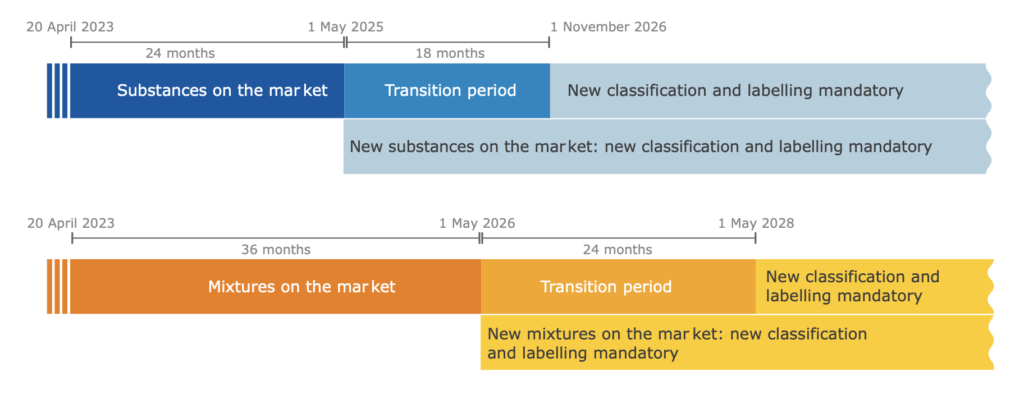
(Reference ECHA website May 2023)
ECHA has updated the harmonised classification and labelling (CLH) proposal template and the combined CLH/biocide template. The templates now include sections for the new hazard classes.
The new hazard classes will be included in IUCLID during spring 2024. From then, manufacturers, importers, downstream users and distributors will be able to include information related to the new hazard classes in their classification and labelling notifications, REACH registrations and dossiers for product and process orientated research and development (PPORD), as well as in their submissions under the Biocidal Products Regulation and poison centre notifications.
Available Guidance
In cooperation with the European Food Safety Authority (EFSA), ECHA is preparing an update of the Guidance on the Application of the CLP criteria to include guidance on the new hazard classes. Following consultations with stakeholders, the updated guidance is planned to be published in mid 2024.
Until then, the following guidance can be used:
For endocrine disruptors: EFSA/ECHA Guidance for the identification of endocrine disruptors in the context of Regulations (EU) No 528/2012 and EC No 1107/2009 https://efsa.onlinelibrary.wiley.com/doi/10.2903/j.efsa.2018.5311
This guidance describes how to perform hazard identification for endocrine disrupting properties by following scientific criteria outlined in Commission Delegated Regulation (EU) 2017/2100 and Commission Regulation (EU) 2018/605 for biocidal products and plant protection products, respectively.
It is used to assess whether a substance meets the criteria for endocrine disruptors under the biocidal or plant protection product regulations. In addition, for the SVHC (substances of very high concern) identification process under the REACH Regulation, principles from this guidance have been used.
The criteria in the biocidal and plant protection product regulations are very similar to the new EU CLP criteria for Category 1. Therefore, the ECHA/EFSA guidance may be applied as such for assessing whether the substance meets the criteria for classification Category 1 (for human health and for the environment). When the evidence available for adversity or endocrine activity or both does not allow a robust conclusion to place a substance in Category 1, for example, due to inconsistencies in results or issues with study design, then Category 2 may be more appropriate.
For persistence and bioaccumulation: Guidance on Information Requirements and Chemical Safety Assessment, Part C: PBT/vPvB assessment (R11), Version 3.0, June 2017
https://echa.europa.eu/documents/10162/17235/information_requirements_part_c_en.pdf/e56a6015-807e-46eb-b808-e5a7dc9fd572?t=1498474748441
Please note that this guidance is also under revision.
https://echa.europa.eu/support/guidance/consultation-procedure/ongoing-reach
The EU CLP criteria for persistence (P), bioaccumulation (B) and toxicity (T) are almost identical to the ones currently in Annex XIII of the REACH Regulation. Accordingly, the Guidance on Information Requirements and Chemical Safety Assessment, Chapter R.11, currently being updated, will provide the first point of reference when evaluating these properties also under CLP.
This R.11 Guidance will be translated into CLP terminology in the Guidance on the Application of the CLP criteria to explain how to compare evidence with the CLP criteria.
Regarding mobility (M), new guidance is under development, including the weight-of-evidence determination for assessing all reliable and relevant information on mobility as a whole.
Chapters for endocrine disruptors, persistence, bioaccumulation, toxicity and mobility will be available by mid 2024.
Application in the UK
The UK government has published an Explanatory Memorandum (EM) on the new EU hazard classes outlining how the new EU Delegated Regulation amending the EU CLP Regulation affects the UK.
The established convention for introducing new hazard classes is to first propose they are introduced into a biennium work programme at the UN GHS where they will be considered, assessed and, if agreed in that forum, added into a revised update (an edition) of UN GHS. The published biennium edition is then typically considered by countries and jurisdictions and adopted into international or national domestic chemicals regulations (in the EU, EU CLP, and in GB, the Great Britain Classification Labelling and Packaging Regulation (‘GB CLP’)).
The EU is introducing new hazard classes directly into the EU CLP Regulation via a delegated act prior to pursuing agreement at the UN GHS level.
The delegated act will not apply in GB but will be implemented directly in Northern Ireland under the Northern Ireland Protocol. This is subject to further developments under the Northern Ireland Protocol Bill or, as is the Government’s preference, through negotiations with the EU. Northern Ireland (NI)-based businesses will be required to classify and label substances placed on the EU Single Market considering the new hazard classes and criteria where they apply.
The new hazard classes and proposed additional amendments will not be automatically added into the GB CLP Regulation because delegated acts relating to directly acting EU Regulations no longer apply in GB following the UK leaving the EU and the end of the transition period.
The UK has no plans to establish similar hazard classes into the GB CLP Regulation without consensus at UN GHS and will consider its position and feed into discussions at UN GHS in the first instance.
The changes to the EU CLP Regulation are intended to increase protection of human health and the environment within the EU but as non-tariff technical barriers to trade, the changes could have an impact on exports and international trade for some years to come until similar or equivalent UN GHS criteria are developed and adopted. However, the UK government believe that it is not certain that following due consideration by the UN GHS Sub-Committee that any of the EU new hazard classes would be introduced into the UN GHS.
Also, the UK government believe that the adoption and establishment of the new hazard classes into the EU CLP Regulation, without first gaining agreement at the United Nations Globally Harmonized System of classification and labelling of chemicals (UN GHS), is a significant break with the established international convention. This will result in not only greater divergence between the GB CLP Regulation and EU CLP systems but greater differences between the EU CLP Regulation and other countries and jurisdictions that adopt UN GHS. This works against an underlying principle of UN GHS to harmonise regulations at a global level and to facilitate trade.
The government will be considering the other amendments in the Commission proposal and the delegated act as part of consideration of potential future reforms to the GB CLP Regulation.
Divergence between the GB CLP Regulation and EU CLP Regulations has occurred since the UK’s withdrawal from the EU and the end of the implementation period but will be exacerbated by the EU’s establishment of new hazard classes and where harmonised classifications have been amended to include the new hazard classes. Businesses supplying to either market must comply with the regulatory requirements of that market. However, provided a compliant CLP hazard label appears on supplied substances and mixtures in each jurisdiction, CLP does not introduce any hindrance to that supply.
Additional supplemental labelling information is allowed under both EU and GB CLP, provided that it does not contradict or distract from the legally required information. This may be expected to include the use of the new hazard classes via the new EUH statements on GB CLP labels
For more information on anything in this Newsletter, please contact us at info@chemregs.co.uk